1. Introduction
Most Port State Control (PSC) detentions feel sudden to ship managers. A vessel arrives in port, an inspection begins, and within hours the ship is held for deficiencies that appear—on the surface—minor or unexpected. However, when PSC detention data is examined across regions rather than case by case, a different picture emerges.
An analysis of Port State Control outcomes across major regimes in 2024 shows that detentions are rarely caused by isolated technical failures or bad luck. Instead, data from the Tokyo and Paris Memoranda of Understanding (MoU) points to predictable operational patterns that consistently trace back to the quality of technical management. While the Tokyo MoU region recorded a marginal decrease in detention rates to 3.71%, the Paris MoU region saw detention levels rise to 4.03%, continuing a three-year trend of elevated non-compliance.
For ship managers and technical superintendents, these figures are not just regulatory statistics. They reflect the effectiveness of shore-side support, the robustness of the Safety Management System (SMS), and—most importantly—the ability of management to maintain standards between inspections. Most detentions are not triggered by the sudden failure of a single critical component; they are the result of gradual operational drift. This drift develops when minor maintenance lapses are tolerated, documentation is prioritised over functional readiness, and the human element is treated as a secondary compliance task.
From an analytical perspective, a ship’s PSC risk profile is not merely a regulatory label. It is a measurable outcome of how consistently management controls operations when no inspector is present.
2. What PSC actually looks for (not what companies think)
Many technical management teams still approach PSC inspections as certificate-driven audits. Modern PSC regimes, however, operate on a clearly defined risk-based methodology designed to eliminate substandard shipping by concentrating inspections on under-performing and unsafe vessels.
Both the Tokyo and Paris MoU apply targeting mechanisms that factor in detention history, company performance, flag State performance, and Recognized Organization (RO) records. In the Tokyo MoU region, the number of under-performing ships—defined as vessels detained three or more times within a 12-month period—rose sharply in 2024, signalling a deterioration in operational standards across certain segments of the fleet.
Crucially, PSC inspections have moved beyond the presence of valid certificates. Port State Control Officers (PSCOs) assess whether there is substantial correspondence between the documented compliance and the ship’s actual condition. When a vessel appears on an under-performing list, a higher level of scrutiny is guaranteed.
PSC authorities have also raised concerns regarding improper conduct, including ineffective remote surveys and unjustified equivalent arrangements that do not align with IMO guidance. The Paris MoU has further highlighted the emergence of “shadow fleet” and “false flag” practices, prompting inspectors to look more closely at the authenticity of registration, certification, and oversight structures.
For ship managers, the practical implication is straightforward: a clean office file offers little protection if the vessel’s operational reality suggests systemic neglect.
3. Top five real detention triggers (management translation)
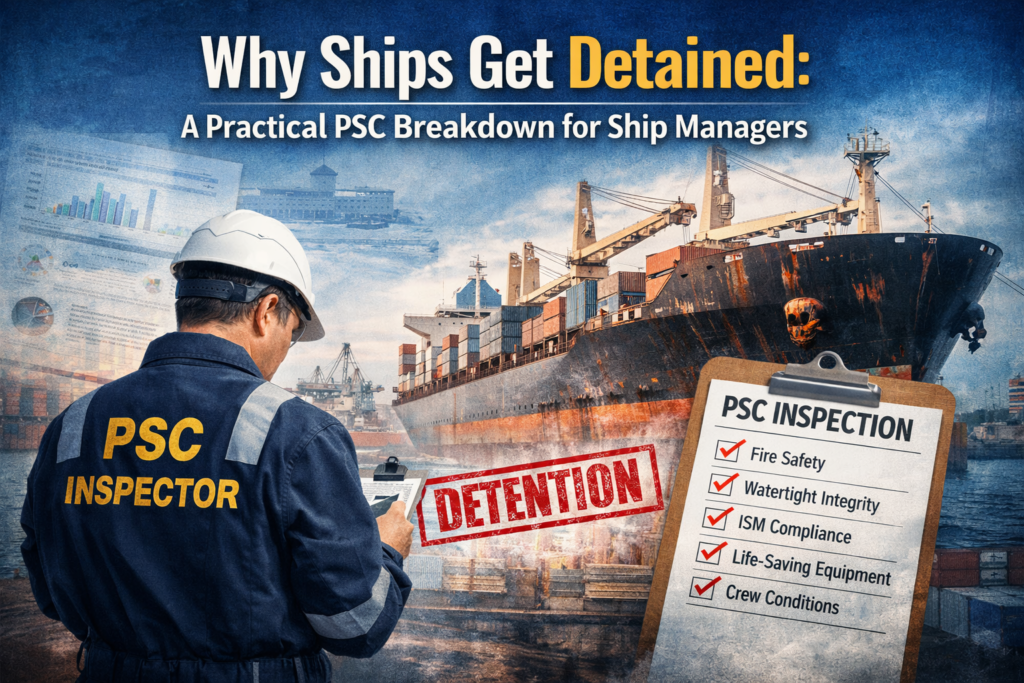
The 2024 MoU reports consistently identify five deficiency groups that most frequently lead to detention. Understanding how these deficiencies arise in operational terms is critical for effective management intervention.
I. Fire safety systems
(Tokyo: 19.87% | Paris: 17.2%)
PSC categorises these deficiencies under SOLAS Chapter II-2, focusing on fire doors, fire-resisting divisions, fire dampers, and fixed fire-extinguishing installations. Operationally, these systems often fail because they remain passive until an emergency occurs, leading to inadequate routine testing and verification.
Management oversight becomes evident when Planned Maintenance Systems (PMS) fail to account for progressive physical wear—particularly in fire dampers, seals, and closures. These components featured repeatedly among detainable items in 2024 and are often overlooked until an inspection exposes long-standing deterioration.
II. Water and weathertight conditions
This was the leading detainable deficiency category in the Tokyo MoU region. Failures typically involve ventilators, air pipes, hatch covers, and associated sealing arrangements. These components are continuously exposed to harsh marine environments and are frequently treated as non-critical as long as cargo spaces remain dry.
From a management perspective, deficiencies emerge when crews lack the time, materials, or prioritisation required for structural maintenance. A dry hold is often assumed to indicate compliance, even when closing appliances no longer meet their design integrity.
III. ISM systemic failures
(Paris: 4.6%)
General ISM deficiencies serve as detention grounds when multiple technical issues indicate a breakdown of the Safety Management System. In practice, this reflects a system that exists on paper but is not functioning effectively onboard.
Detentions linked to “maintenance of ship and equipment” highlight failures in providing a workable maintenance framework rather than isolated technical shortcomings. These are management failures, not crew errors, and PSC regimes increasingly recognise them as such.
IV. Life-saving appliances (LSA)
Lifeboats and their launching arrangements remain frequent detention triggers under SOLAS Chapter III. Issues commonly arise from inadequate crew familiarisation, seized or poorly lubricated release mechanisms, and deferred servicing.
Management oversight is evident when shore-side teams assume that the physical presence of LSA equates to readiness, without verifying operational competence or training effectiveness. PSC inspections routinely expose this disconnect.
V. Working and living conditions (MLC 2006)
Deficiencies under MLC Title 4—covering health protection, medical care, and accommodation—accounted for approximately 10% of main group deficiencies in the Paris MoU in 2024. These issues often stem from denied access to medical care, deteriorating accommodation standards, or poor hygiene conditions.
PSC regimes are increasingly using seafarer welfare as an indicator of overall safety culture. Failures in this area reflect management priorities rather than isolated onboard behaviour.
4. Why paperwork alone doesn’t save ships
The 2024 data highlights a persistent gap between administrative compliance and operational reality. Vessels with valid certificates are still detained when those certificates are linked to ineffective surveys or extensions that fall outside international convention limits.
Both Tokyo and Paris MoU reports raise concerns about certificates issued following remote surveys that fail to verify safety-critical conditions onboard. In such cases, the existence of documentation does not shield a ship from detention when functional compliance cannot be demonstrated.
The 2024 Concentrated Inspection Campaign (CIC) on Crew Wages and Seafarer Employment Agreements (SEA) illustrates this clearly. Ships were detained not only for missing or unsigned SEAs, but also because seafarers could not access or understand their employment conditions. In several cases, documentation existed but was not operationalised.
PSC authorities increasingly validate compliance through crew interviews. A document locked in the master’s safe does not constitute compliance if it does not reflect the crew’s lived working conditions.
5. How operational failures turn into PSC findings
Operational failures rarely occur in isolation. They develop as patterns of behaviour that eventually manifest as detainable deficiencies. Repeated issues with auxiliary engines, oil filtering equipment, or pollution prevention systems often indicate overwhelmed crews or unaddressed defect backlogs.
When management tolerates a growing list of “non-essential” repairs, critical systems—including safety of navigation equipment—are eventually affected. Deficiencies related to SOLAS Chapter V and emergency systems continue to rise, suggesting a reactive rather than preventive operational culture.
Crew unfamiliarity with equipment further accelerates this progression. Inability to demonstrate passage planning, operate ECDIS correctly, or respond effectively to alarms leads PSCOs to question the broader safety culture onboard. When shore-side corrective actions are delayed due to cost or scheduling pressures, these same issues escalate into detentions that impose far greater financial and reputational costs.
6. What ship managers should focus on
To reduce PSC exposure and achieve a Low Risk or White List profile, ship managers must translate PSC findings into concrete management actions:
- Systemic maintenance (ISM compliance): Treat maintenance of ship and equipment as a core ISM function. Internal audit data should be used to identify recurring issues—such as fire doors and ventilators—before PSC inspections do.
- The human element (MLC Title 4): Prioritise seafarer health protection, welfare, and access to information. Rising MLC deficiencies indicate that PSC regimes now view crew living conditions as a proxy for management quality.
- Internal verification of hardware: Pre-inspection checks should focus on high-impact areas, particularly fire safety systems and life-saving appliances, which together account for a significant proportion of detentions.
- Company performance monitoring: The Tokyo MoU’s publication of under-performing companies reinforces the need to track company Excess Factor (EF) and performance trends against regional averages.
- Verification of RO and flag oversight: Managers must ensure that their Recognized Organizations and flag States are providing effective oversight. The 2024 data reflects growing scrutiny of RO performance in relation to detainable deficiencies.
7. Conclusion
PSC detentions in 2024 are not the result of bad luck or overly aggressive inspections. They are the visible outcome of long-term operational drift. Whether the finding is a rusted ventilator in the Tokyo region or a non-functional fire door in the Paris region, these deficiencies are symptoms of management systems that have allowed standards to erode over time.
In practice, PSC inspections do not fail ships; they reveal how a company operates when no one is watching. The most effective way to reduce PSC risk is not intensive inspection preparation, but consistent, well-controlled operations. When technical management prioritises functional maintenance and seafarer welfare over administrative appearance, vessels naturally align with PSC expectations—and move from being enforcement targets to standard or low-risk performers.